
Access Denied
IMPORTANT! If you’re a store owner, please make sure you have Customer accounts enabled in your Store Admin, as you have customer based locks set up with EasyLockdown app. Enable Customer Accounts
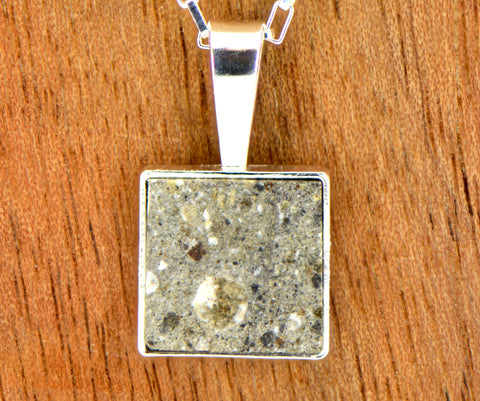
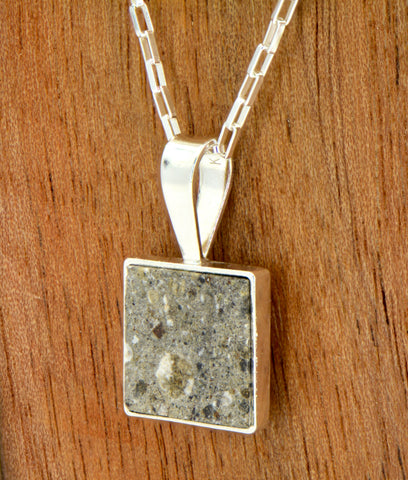
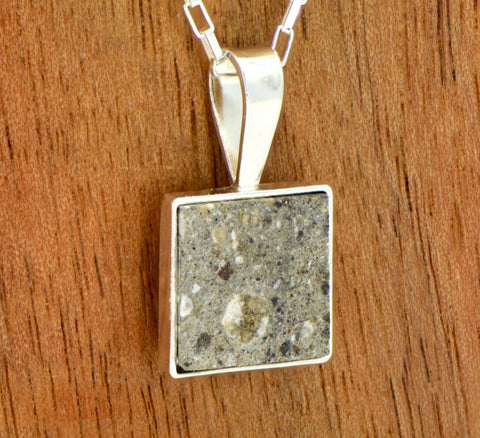
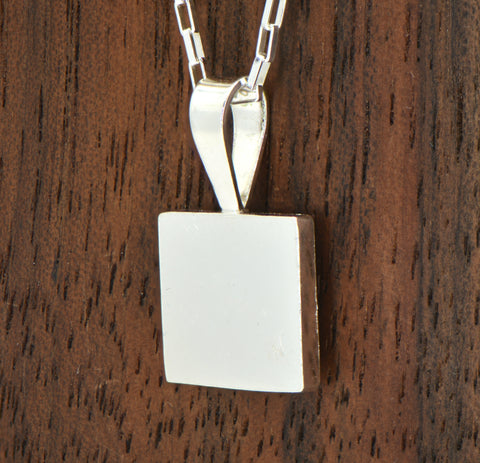
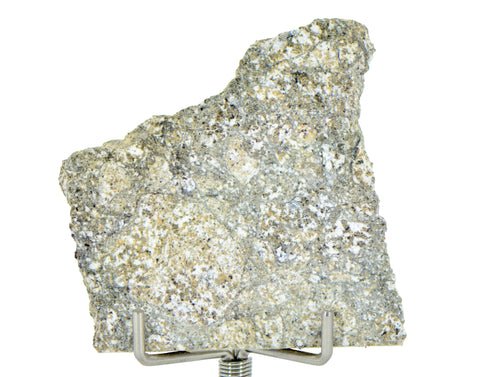
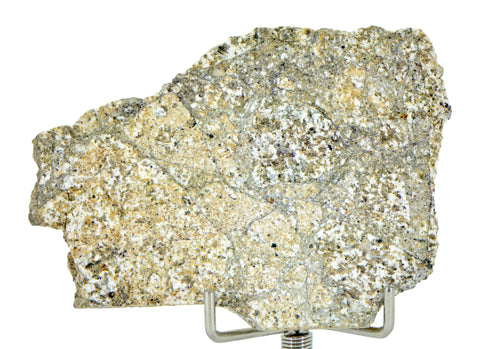
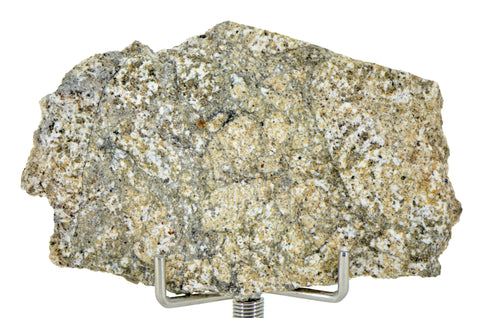
Beautiful Howardite HED Meteorite Pendant - Meteorite Jewelry - Sterling Silver
Top Meteorite
- $ 250.00
On Offer: Pendant with center stone fashioned from the NWA 11899 Howardite HED meteorite and set in 925 Sterling Silver.
Dimensions not including bail: Approximately 13.5 mm x13.5 mm x 2.75 mm
Dimensions including bail: Approximately 23.65 mm x13.5 mm x 5.93 mm
Center Stone: Howardite
Official name: NWA 11899
Parent Body: Vesta or Vestoid
Description: Pendant with center stone fashioned from the NWA 11899 Howardite HED meteorite and set in 925 Sterling Silver. Silver Chain is available.
The HED Meteorite Clan: petrological evidence and data from NASA's Dawn mission indicate that nearly monomineralic ultramafic orthopyroxenite, olivine-bearing, and the much more rare harzburgitic, and dunite diogenites formed alongside each other. They likely originated as cumulates within localized magma chambers (plutons) situated across Vesta's lower crust and the lower-crust/upper-mantle transition zone. While the eucrites represent more evolved plagioclase rich mafic upper to middle zone crustal material. The howardites were formed by impact mixing of the diogenitic and eucritic material both in situ and during ejection events.
The HED meteorites are so named for the three types of meteorites that comprise the group; Howardite, Eucrite and Diogenite. The Eucrite and Diogenite are meteorites with distinct chemistries, while the Howardite is a mix of the eucritic and diogenitic material. The HEDs are differentiated achondritic meteorites, thought to originate from the large differentiated asteroid 4 Vesta. Vesta is one of the only asteroids visible with the naked eye and low powered telescopes.
The Vesta parent body origin for the HED clan of meteorites is considered to have been conclusively established for many years. However, the late Dr. John Wasson, a planetary science researcher from UCLA had long held that the HED meteorite clan originated from another unknown Vesta-like asteroid that was blown apart long ago. This is because we also find a class of iron meteorites with nearly identical oxygen isotopes as the HED clan. This along with other research lead Dr. Wasson to conclude the HED clan of meteorites come from another differentiated V-type asteroid that was in a cataclysmic collision liberating part or all of its metal core along with the HED meteorites.
However, this hypothesis does not necessarily rule out the possibility that a "reaccreted" Vesta and the smaller V-type asteroids collectively known as Vestoids along with the HED meteorites and the isotopically paired irons were all once part of a much larger dwarf planet prior to a massive collision with another large body. While most researchers consider the case mostly closed on this debate, the paradox of isotopically paired core metal raised by Dr. Wasson's hypothesis has not been resolved. This leaves some to speculate that perhaps we still have more to learn about this fascinating clan of achondrite meteorites and even Vesta itself.
The HED meteorites are so named for the three types of meteorites that comprise the group; Howardite, Eucrite and Diogenite. The Eucrite and Diogenite are meteorites with distinct chemistries, while the Howardite is a mix of the eucritic and diogenitic material. The HEDs are differentiated achondritic meteorites, thought to originate from the large differentiated asteroid 4 Vesta. Vesta is one of the only asteroids visible with the naked eye and low powered telescopes.
The Vesta parent body origin for the HED clan of meteorites is considered to have been conclusively established for many years. However, the late Dr. John Wasson, a planetary science researcher from UCLA had long held that the HED meteorite clan originated from another unknown Vesta-like asteroid that was blown apart long ago. This is because we also find a class of iron meteorites with nearly identical oxygen isotopes as the HED clan. This along with other research lead Dr. Wasson to conclude the HED clan of meteorites come from another differentiated V-type asteroid that was in a cataclysmic collision liberating part or all of its metal core along with the HED meteorites.
However, this hypothesis does not necessarily rule out the possibility that a "reaccreted" Vesta and the smaller V-type asteroids collectively known as Vestoids along with the HED meteorites and the isotopically paired irons were all once part of a much larger dwarf planet prior to a massive collision with another large body. While most researchers consider the case mostly closed on this debate, the paradox of isotopically paired core metal raised by Dr. Wasson's hypothesis has not been resolved. This leaves some to speculate that perhaps we still have more to learn about this fascinating clan of achondrite meteorites and even Vesta itself.
What you get: Pendant with center stone fashioned from the NWA 11899 Howardite HED meteorite and set in 925 Sterling Silver, membrane shipping/storage box, & signed Certificate of Authenticity.
* .925 Sterling Silver chain is available.
Top Meteorite offers a 100% no questions asked 30 day return policy.
SEE OFFICIAL METEORITICAL SOCIETY ENTRY BELOW
| Northwest Africa 11899 | |||||||||||||||||||||||||||||
|---|---|---|---|---|---|---|---|---|---|---|---|---|---|---|---|---|---|---|---|---|---|---|---|---|---|---|---|---|---|
| Basic information |
Name: Northwest Africa 11899 This is an OFFICIAL meteorite name. Abbreviation: NWA 11899 Observed fall: No Year found: 2017 Country: Mali Mass:  16 kg 16 kg |
||||||||||||||||||||||||||||
| Classification history: |
This is 1 of 356 approved meteorites classified as Howardite. [show all] Search for other: Achondrites, HED achondrites, and Howardites |
||||||||||||||||||||||||||||
| Comments: | Approved 31 Aug 2018 | ||||||||||||||||||||||||||||
| Writeup |
Writeup from MB 107:
Northwest Africa 11899 (NWA 11899) Mali Purchased: 2017 Classification: HED achondrite (Howardite) History: Purchased by Dustin Dickens from Nomad in Mali. Physical characteristics: Many identically appearing pieces. Fusion crusted exterior. A saw cut reveals a breccia with light and dark clasts set in light-brown matrix. Petrography: (C. Agee, UNM) This meteorite is a polymict breccia consisting of approximately 60% diogenite and 40% eucrite clasts. Accessory Fe-Ni metal, Fe-sulfide, and silica observed. Geochemistry: (C. Agee, UNM) diogenite low-Ca pyroxene Fs25.1±2.5Wo3.6±2.2, Fe/Mn=30±2, n=10; eucrite low-Ca pyroxene Fs49.7±5.2Wo4.8±2.8, Fe/Mn=29±2, n=7;.plagioclase AN93.1±1.2, n=7. Classification: Howardite Specimens: 22.8 g including a probe mount on deposit at UNM, Dustin Dickens holds the main mass. |
||||||||||||||||||||||||||||
| Data from: MB107 Table 0 Line 0: |
|
||||||||||||||||||||||||||||
We Also Recommend


Invalid password
Enter